

Healthcare Arbitration in India: Hospital Disputes | LegalMedico
Healthcare Law · Arbitration · Commercial Disputes

Healthcare Arbitration in IndiaWhy Healthcare Is Becoming Arbitration-Heavy

Hospital acquisitions, insurer relationships, doctor contracts, diagnostic outsourcing and health-tech are creating a new contractual dispute ecosystem in India. But the shift is occurring mainly at the commercial and institutional layer—not by replacing consumer, criminal or regulatory remedies.
LegalMedico Analysis · Updated 7 September 2026
Healthcare arbitration in India — professionals reviewing a hospital commercial agreement
Advocate Lokesh Bagani, Founder and Editor of LegalMedico
About the author

Adv. Lokesh Bagani

Founder & Editor, LegalMedico

Adv. Lokesh Bagani writes on healthcare law, medico-legal regulation, hospital disputes, cyber law, digital evidence and arbitration, with a focus on the legal and procedural issues arising in healthcare institutions. View author profile.

Core thesis: healthcare is becoming more arbitration-relevant because modern healthcare is becoming more contractual, capital-intensive, outsourced and technology-dependent.
What this article does claim: commercial healthcare relationships are creating more contexts in which arbitration clauses matter.

What it does not claim: that all healthcare disputes are arbitrable, or that patient consumer claims, criminal proceedings or regulatory jurisdiction can be contracted away.

Healthcare arbitration in India is becoming increasingly relevant at the commercial and institutional layer of healthcare. Ask a lawyer what a healthcare dispute looks like and medical negligence will probably be the first answer. That picture is now incomplete. Behind a modern hospital sits a network of investors, promoters, insurers, third-party administrators, doctors, diagnostic operators, software vendors, equipment suppliers, landlords, management companies and sometimes public authorities. Their relationships are governed not by clinical consent forms, but by healthcare contracts and commercial agreements.

That distinction matters. A hospital may simultaneously be a provider of medical services to a patient, an empanelled network provider for an insurer, an employer or principal for senior clinicians, a customer of a hospital-information-system vendor, a concessionaire, a borrower and the subject of an acquisition agreement. Each legal relationship creates a different forum question, evidence problem and risk allocation.

The commercial backdrop: healthcare is attracting capital, capacity and consolidation

The strongest evidence for the thesis is not a supposed national count of “healthcare arbitrations”—no reliable India-wide dataset presently supports such a percentage claim. The better evidence is structural: healthcare transactions, capacity expansion and private credit are increasing the number and complexity of commercial relationships around hospitals.

₹10,000+ crAnnounced transactions across hospitals, diagnostics and specialty care in Q2 FY26, according to EY-Parthenon.
18,000+ bedsPlanned additions by leading hospital chains over the next three to five years, per EY-Parthenon.
13%Healthcare share of India private-credit deal value in H1 2026, according to the EY report cited by IBEF.
10–16%Year-on-year ARPOB growth reported across leading hospital networks in EY-Parthenon’s Q2 FY26 update.

EY-Parthenon reported more than ₹10,000 crore of announced transactions across hospitals, diagnostics and specialty care in Q2 FY26, including buyouts, minority investments and cross-border acquisitions. The same update said leading hospital chains collectively planned more than 18,000 additional beds over the following three to five years. It also reported 10–16% year-on-year ARPOB growth across leading hospital networks. Separately, IBEF’s summary of the EY Private Credit Report H1 2026 said healthcare accounted for 13% of private-credit deal value, making it the second-largest sector by deployment.
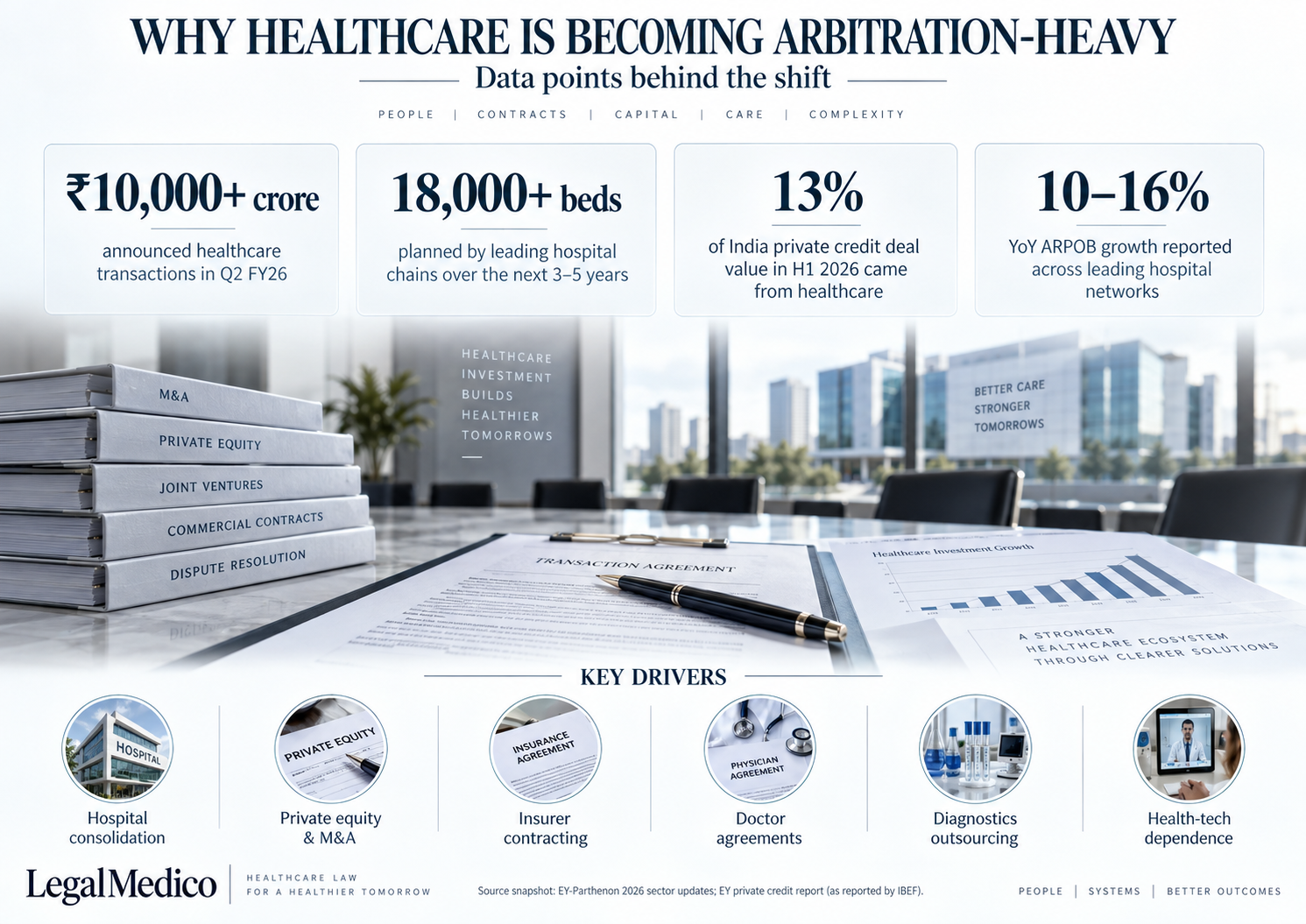
Data points behind the growth of commercial healthcare relationships in India
Selected commercial indicators behind the expansion of contractual relationships in Indian healthcare. Source references appear at the end of this article.

A modern hospital is a contract ecosystem

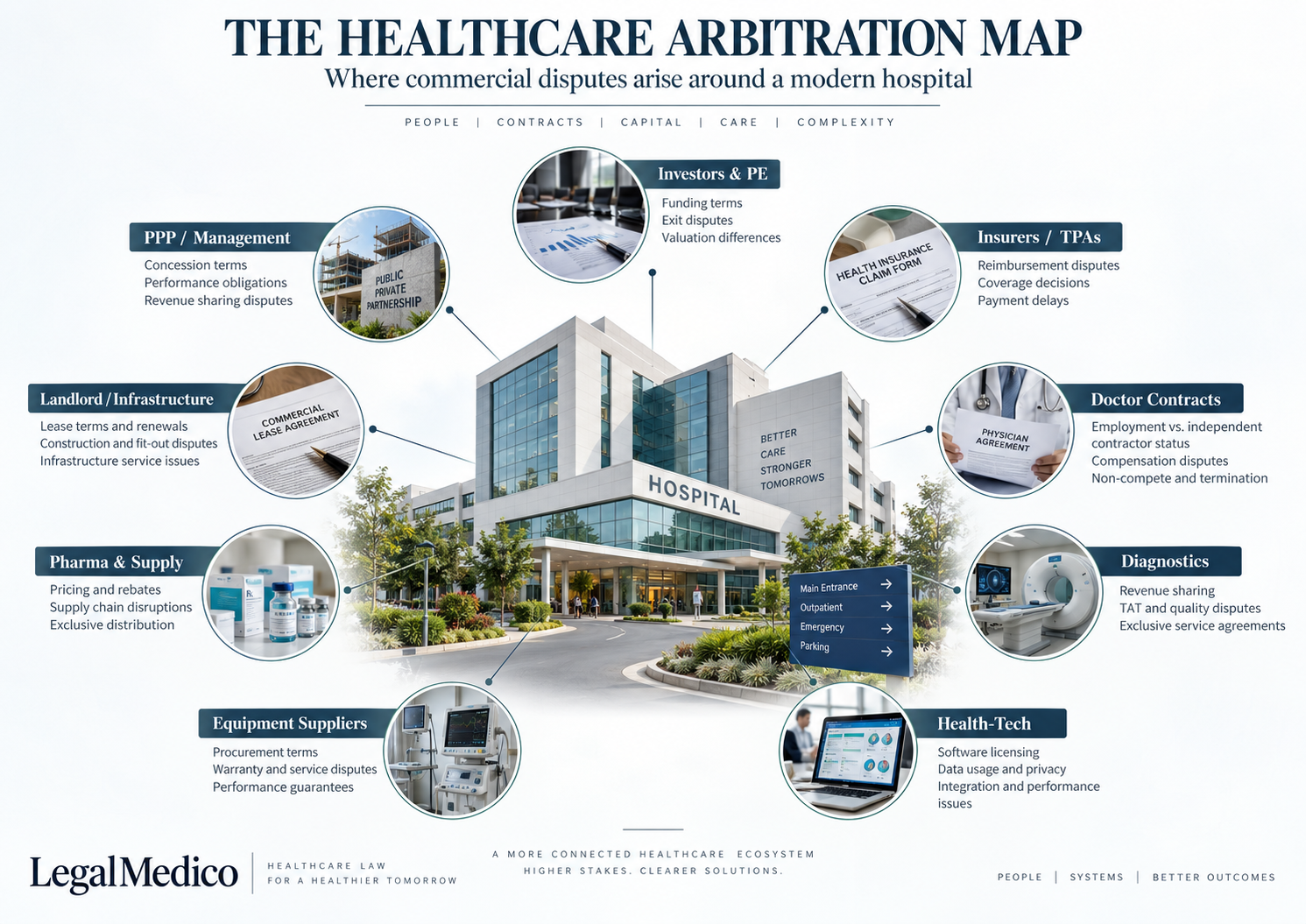
The hospital is now only the centre of the diagram. Around it sit numerous bilateral and multi-party relationships: shareholder agreements, share purchase agreements, doctor engagement contracts, insurer empanelment agreements, diagnostic service arrangements, equipment procurement and maintenance contracts, software implementation agreements, leases, financing documents, management agreements and public-private partnership structures.

Arbitration becomes relevant because sophisticated commercial parties often choose it in advance as their dispute-resolution mechanism. The Arbitration and Conciliation Act, 1996 supplies the procedural architecture: an arbitration agreement under Section 7, reference and appointment mechanisms, court interim protection under Section 9, tribunal interim measures under Section 17, jurisdictional objections under Section 16, challenge under Section 34 and enforcement under Section 36.

Healthcare arbitration map showing commercial relationships around a modern hospital
The commercial relationships around a hospital can produce very different contractual disputes, evidence records and forum questions.

Recent Indian cases show what “healthcare arbitration” actually looks like

The following cases are useful precisely because they are not medical-negligence disputes. They arise from the institutional layer of healthcare: insurer empanelment, diagnostic facilities, health-tech implementation and a senior doctor/key-person agreement.

Case Window 01 · Delhi High Court · 14 August 2026

Retina Speciality Hospital v Care Health Insurance Ltd.

Proceeding
ARB.P. 1415/2026 under Section 11(6)
Relationship
Hospital ↔ health insurer
Underlying agreement
Service Agreement dated 12 October 2022
Dispute described by court
Suspension of the hospital’s services and subsequent exclusion from the insurer’s network of empanelled service providers
Procedural stage
Notice issued; the 14 August order was not a final merits determination.

The hospital invoked Article 16-Clause 11 of the service agreement and nominated an arbitrator. According to the order, the respondent did not appoint its nominee or respond to the invocation notice, after which the hospital approached the Delhi High Court under Section 11.

Litigation takeaway
Hospital–insurer disputes are not the same thing as patient–insurer disputes. A network-provider agreement can generate a separate B2B arbitration controversy involving empanelment, contractual suspension and commercial rights.
Case Window 02 · Madhya Pradesh High Court · 20 March 2026

Falguni Nirman Pvt Ltd v Hamidia Hospital

Proceeding
AC No. 131 of 2025
Relationship
Hospital / medical institution ↔ diagnostic service provider
Contract
Setting up, operation, management and maintenance of CT and MRI diagnostic facilities at Hamidia Hospital, Bhopal
Disputes
Payments and whether the contract tenure stood extended from seven years to ten

The arbitration clause first contemplated mutual discussion and conciliation and, on failure, reference to a sole arbitrator. The respondent argued that the Section 11 application was premature because the conciliation step had not been completed. The High Court rejected the objection in the circumstances, noting the seriousness of the dispute and that relegating the parties to an empty formality would serve little purpose; it proposed appointment of a former judge as sole arbitrator.

Counsel’s note
Multi-tier dispute clauses can themselves become the first dispute. Draft whether negotiation or conciliation is mandatory, specify a time limit, identify when the step is exhausted and preserve urgent interim remedies.
Case Window 03 · Supreme Court · 6 November 2025 · 2025 INSC 1289

Alchemist Hospitals Ltd v ICT Health Technology Services India Pvt Ltd.

Proceeding
Appeal from dismissal of a Section 11(6) application
Relationship
Hospital ↔ health-technology vendor
Commercial context
Hospital-management software implementation intended to integrate patient care, billing, diagnostics and records
Holding
The clause did not amount to a valid arbitration agreement merely because it used arbitration terminology.

This is the doctrinally most important case in the article. The Supreme Court examined the substance of the dispute-resolution clause and held that the parties had not manifested the necessary intention to submit disputes to binding adjudication by an arbitral tribunal. The case is a direct warning against relying on headings or loose ADR language.

Drafting warning
Nomenclature is not enough. A healthcare contract may contain a heading saying “Arbitration” and still fail Section 7 if the clause does not create a clear, binding adjudicatory mechanism.
Case Window 04 · Delhi High Court · 28 May 2024

Manipal Hospitals (Dwarka) Pvt Ltd v Dr Sanjeev Bagai

Proceeding
O.M.P. (COMM) 418/2023 under Section 34
Relationship
Hospital ↔ senior doctor/key personnel
Agreement
Key Personnel Management Agreement dated 26 February 2014, amended 15 March 2016
Claim
₹44.94 crore plus interest was claimed in arbitration.

The arbitral tribunal awarded ₹16.02 crore towards compensation for the balance contractual period, ₹15 crore towards loss of terminal benefits, interest and costs. On challenge, the Delhi High Court upheld the ₹16.02 crore compensation component and the finding of wrongful termination, but set aside the independent ₹15 crore terminal-benefit component as severable.

Litigation takeaway
Doctor–hospital contracts can generate high-value commercial arbitration. The dispute may involve termination rights, compensation, lock-in provisions, notional equity, mitigation, proof of loss and the narrow scope of Section 34 review.
Illustrative Indian healthcare arbitration cases involving hospitals, insurers, diagnostics, technology and doctor contracts
Illustrative cases from the institutional healthcare layer. Each must be read in its actual procedural posture; not every case resulted in a final arbitral adjudication.

Hospital–insurer arbitration may become one of the most important B2B healthcare dispute categories

Hospital empanelment agreements can produce disputes over tariff schedules, audits, clawbacks, recoveries, alleged overbilling, claim reconciliation, suspension, de-empanelment and contractual termination. These disputes are commercially significant because the hospital and insurer may need to continue interacting across hundreds or thousands of patient episodes even while contractual disagreements accumulate.

The forum question must therefore begin with the correct relationship. A patient challenging denial of an insurance claim is in a different legal position from a hospital enforcing an empanelment or service agreement against the insurer.

Doctor–hospital contracts are no longer simple retainership letters

Senior clinicians may be engaged under elaborate arrangements involving fixed remuneration, revenue sharing, minimum guarantees, exclusivity, key-person obligations, notice periods, restrictive covenants, confidentiality, intellectual property, notional equity or performance-linked payments. When these arrangements fail, the dispute can involve both contract law and professional realities unique to healthcare.

The Manipal dispute illustrates why drafting must distinguish employment-type obligations, independent professional practice, termination triggers, compensation consequences and post-termination rights. An arbitration clause does not validate an otherwise unlawful restrictive covenant; validity of the substantive obligation and arbitrability are separate questions.

Health-tech disputes add data, uptime and patient-continuity risk

A hospital information system is not ordinary enterprise software. It may hold admission data, clinical documentation, billing records, laboratory results, radiology workflows, pharmacy data and audit trails. A dispute over implementation or termination can therefore affect both money and care delivery.

Healthcare technology agreements should address implementation milestones, acceptance testing, service levels, cybersecurity responsibility, incident cooperation, data ownership or control, export formats, migration assistance, business continuity, audit logs, access after termination and evidence preservation. The Alchemist Hospitals litigation shows an even more basic lesson: before any of those issues can be arbitrated, the contract must contain a legally valid arbitration agreement.

Where arbitration stops: the patient and statutory layer remains different

The phrase “healthcare arbitration” becomes misleading if it suggests that private contracts can displace every legal forum. They cannot. Consumer jurisdiction, criminal process, professional discipline and statutory regulatory enforcement arise from different legal sources.

Emaar MGF Land Ltd v Aftab Singh was not a healthcare case. It arose in the consumer-law context and is relevant here for the broader principle that an arbitration clause does not, by itself, compel a consumer to abandon a special statutory consumer remedy. In healthcare, the foundational Supreme Court decision in Indian Medical Association v V.P. Shantha recognised that medical services rendered for consideration can fall within consumer law, subject to the factual and statutory framework applicable to the service. Read together, these authorities are a reminder that a hospital cannot assume that an arbitration clause embedded in admission documentation will automatically eliminate a patient’s statutory consumer remedy.

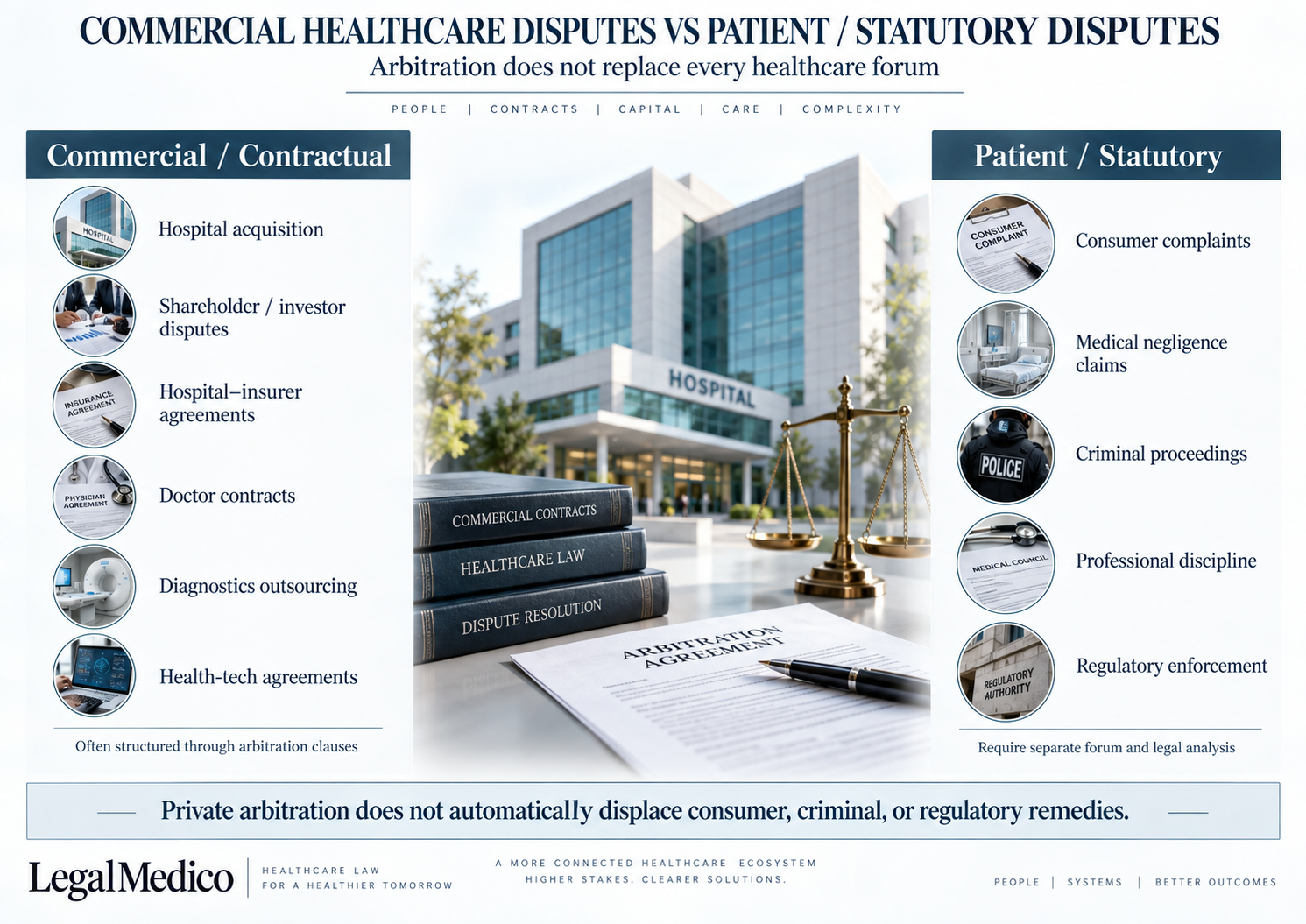
Comparison between commercial healthcare disputes and patient or statutory healthcare disputes
Private arbitration and statutory healthcare remedies occupy different legal spaces. Forum analysis depends on the right asserted and the source of that right.

The typical healthcare arbitration journey

ContractDispute crystallisesInvocation noticeSection 9 if urgent reliefTribunal constitution / Section 11Section 16 objectionsPleadings & evidenceAwardSection 34Enforcement

The sequence looks familiar to any arbitration practitioner, but healthcare changes the operational stakes. Interim relief may involve continued access to systems or equipment; evidence may sit inside clinical IT infrastructure; termination can affect patient services; confidentiality may overlap with sensitive health information; expert evidence may need to explain both technical and healthcare-operational questions.

Evidence matrix: what actually decides healthcare commercial arbitrations?

The arbitration clause gets the parties into arbitration. The contemporaneous records usually decide what happens there.

Dispute typeTypical evidence that matters
Hospital–insurerEmpanelment agreement, tariff schedules, claim files, audit reports, recovery notices, reconciliation statements, emails, suspension/de-empanelment communications
Doctor–hospitalEngagement agreement, amendments, compensation records, performance correspondence, termination notice, board/HR records, evidence of mitigation and subsequent earnings where relevant
Diagnostics outsourcingConcession/service agreement, equipment records, turnaround-time reports, revenue-share statements, invoices, maintenance logs, site handover records
Health-techImplementation plan, UAT records, SLA metrics, uptime logs, support tickets, data-migration records, access logs, emails, cybersecurity incident records
Hospital M&A / investmentSPA, SHA, disclosure schedules, due-diligence materials, valuation reports, board minutes, earn-out calculations, indemnity notices, audited accounts
Equipment / infrastructurePurchase or lease contract, commissioning records, warranties, AMC logs, downtime reports, performance guarantees, payment records

What a healthcare arbitration clause should actually cover

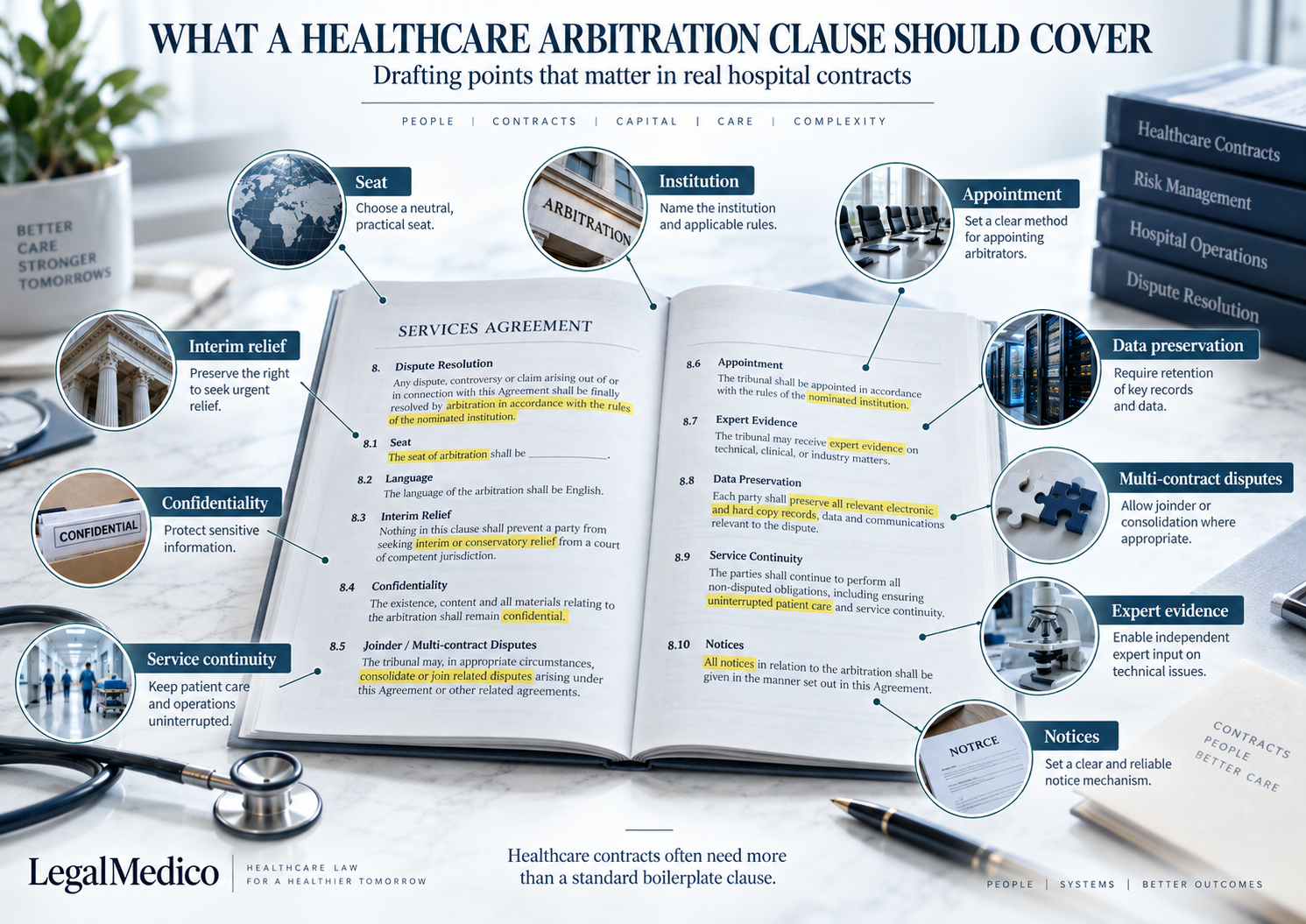
A healthcare contract often needs more than boilerplate. At minimum, counsel should test the clause for a clear and binding agreement to arbitrate, governing law, seat, tribunal composition and appointment, institutional or ad hoc procedure, language, interim relief, notice mechanics and interaction with related contracts.

Healthcare-specific drafting may also require service-continuity obligations, patient-data access, preservation of medical and electronic records, transition assistance, cyber-incident cooperation, non-disputed payment obligations, equipment possession, regulatory cooperation and expert determination for narrowly technical issues.

Drafting points for a healthcare arbitration clause including seat, appointment, interim relief, confidentiality and data preservation
A drafting checklist, not a model clause. The exact language should be tailored to the contract, transaction structure and governing institutional rules.

Why this matters for healthcare lawyers and hospital leadership

The next generation of healthcare disputes will require professionals who can read both the contract and the hospital. A purely clinical understanding is insufficient for an M&A indemnity dispute; a purely commercial understanding may miss the consequences of shutting down an HIS module, withdrawing diagnostic equipment or interrupting a critical outsourced service.

The better approach is interdisciplinary: contract architecture, healthcare regulation, evidence, technology, finance and arbitration procedure. This is particularly important at the drafting stage, because many of the hardest disputes begin with a clause that did not anticipate how a hospital actually operates.

Healthcare arbitration is growing in relevance not because healthcare has suddenly become a different kind of industry, but because the industry’s legal relationships have multiplied. Hospitals are now networks of capital, professional services, insurance, technology and infrastructure. The more contractual those relationships become, the more frequently arbitration law enters the conversation.

Frequently asked questions about healthcare arbitration in India

What is healthcare arbitration in India?

Healthcare arbitration generally refers to arbitration arising from commercial or contractual relationships in the healthcare sector. Typical examples include hospital–insurer agreements, hospital acquisitions and shareholder arrangements, doctor consultancy or key-person contracts, diagnostic outsourcing, health-tech implementation agreements, equipment procurement and hospital management arrangements. It should not be treated as a synonym for every dispute involving a hospital or doctor.

Are medical negligence disputes arbitrable in India?

Not automatically. Medical-negligence disputes may engage consumer, civil, criminal or professional-regulatory remedies depending on the facts. A private arbitration clause does not by itself displace statutory consumer jurisdiction, criminal process or disciplinary jurisdiction. The legal route must be assessed separately from a hospital's commercial contracts.

Can a hospital and an insurance company resolve disputes through arbitration?

Yes, where their commercial agreement contains a valid arbitration clause and the dispute falls within that contractual relationship. The Retina Speciality Hospital v Care Health Insurance Ltd. proceeding illustrates a Section 11 petition arising from a hospital–insurer service agreement. This B2B relationship is legally distinct from a patient's insurance claim against an insurer.

Can doctor–hospital contractual disputes be arbitrated?

Potentially yes. Disputes concerning consultancy agreements, remuneration, revenue sharing, termination, confidentiality, lock-in obligations and other commercial terms may be referred to arbitration where a valid arbitration agreement exists and the subject matter is arbitrable. The Manipal Hospitals (Dwarka) Pvt Ltd v Dr Sanjeev Bagai litigation arose from an arbitral award under a key personnel management arrangement.

Can a patient be forced into arbitration because a hospital document contains an arbitration clause?

Not merely because such a clause exists. The Supreme Court's consumer-arbitration jurisprudence, including Emaar MGF Land Ltd v Aftab Singh, makes clear that statutory consumer remedies are not automatically displaced by a private arbitration agreement. Emaar MGF was not a healthcare case, but the principle is relevant when analysing attempts to contract out of statutory consumer jurisdiction. Paid medical services are separately governed by the consumer-law framework recognised in Indian Medical Association v V.P. Shantha, subject to the applicable facts and current law.

What makes an arbitration clause valid under Indian law?

Section 7 of the Arbitration and Conciliation Act, 1996 requires a clear agreement to submit disputes to arbitration. Merely using the word “arbitration” is not enough if the clause does not reveal an intention to obtain binding adjudication from an arbitral tribunal. The Supreme Court's decision in Alchemist Hospitals Ltd v ICT Health Technology Services India Pvt Ltd. is an important healthcare-sector example of this drafting point.

What kinds of hospital disputes are commonly arbitration-relevant?

Commercial disputes that may be arbitration-relevant include hospital acquisitions and shareholder disputes, hospital–insurer and TPA arrangements, diagnostic outsourcing, healthcare software implementation, doctor consultancy contracts, equipment procurement, hospital management arrangements, investment agreements and certain financing or infrastructure disputes. Arbitrability still depends on the agreement, the nature of the rights involved and the governing law.

Which provisions of the Arbitration and Conciliation Act commonly arise in healthcare disputes?

Depending on the dispute, important provisions may include Section 7 on the arbitration agreement, Section 9 on interim measures by courts, Section 11 on appointment of arbitrators, Section 16 on tribunal jurisdiction, Section 17 on interim measures by the tribunal, Section 34 on challenge to an award and Section 36 on enforcement. Institutional rules, contractual governing law and sector-specific regulation may also be relevant.

What evidence is important in a healthcare commercial arbitration?

The evidentiary record may include executed contracts and amendments, board resolutions, emails and correspondence, insurer reconciliation statements, billing and payment records, audit reports, HIS or EMR system logs, SLA and uptime records, implementation milestones, termination notices, valuation reports, due-diligence disclosures, regulatory correspondence and expert evidence. In many healthcare disputes, contemporaneous operational records matter as much as the arbitration clause itself.

Can arbitration stop criminal, consumer or regulatory proceedings against a hospital or doctor?

No. A private arbitration agreement cannot by itself extinguish criminal jurisdiction, statutory consumer remedies, professional disciplinary proceedings or regulatory enforcement. Different proceedings may coexist because they protect different rights and involve different legal consequences.

What should a healthcare arbitration clause specifically address?

Beyond ordinary commercial drafting, healthcare contracts should consider the seat and governing law, appointment mechanism, interim relief, confidentiality, multi-contract disputes, patient-data protection, preservation and access to medical records, continuity of critical services, HIS or EMR handover, cybersecurity cooperation, equipment possession, regulatory cooperation and obligations that survive termination. The appropriate clause must still be tailored to the particular transaction and cannot be reduced to a generic template.

Sources and research note

  1. EY-Parthenon India, “India’s healthcare sector records cumulative deal value of over INR 10,000 crore in Q2 FY26”, 15 January 2026: EY.
  2. IBEF, “Healthcare ranks second in private credit deals as domestic funds dominate in H1 2026: EY report”, 1 September 2026: IBEF.
  3. Retina Speciality Hospital v Care Health Insurance Ltd., Delhi High Court, ARB.P. 1415/2026, order dated 14 August 2026: text.
  4. Falguni Nirman Pvt Ltd v Hamidia Hospital, Madhya Pradesh High Court, AC No. 131 of 2025, order dated 20 March 2026: text.
  5. Alchemist Hospitals Ltd v ICT Health Technology Services India Pvt Ltd., Supreme Court of India, 2025 INSC 1289, 6 November 2025: Supreme Court PDF.
  6. Manipal Hospitals (Dwarka) Pvt Ltd v Dr Sanjeev Bagai, Delhi High Court, O.M.P. (COMM) 418/2023, 28 May 2024: text.
  7. The Arbitration and Conciliation Act, 1996: India Code.
  8. Emaar MGF Land Ltd v Aftab Singh, Supreme Court of India, review judgment dated 10 December 2018: Supreme Court PDF.
  9. Indian Medical Association v V.P. Shantha, Supreme Court of India, judgment dated 13 November 1995, (1995) 6 SCC 651: Supreme Court PDF.

Author: Adv. Lokesh Bagani · Founder & Editor, LegalMedico

Legal, Research & Publication DisclaimerThis article is published solely for legal education, research and professional discussion. It is based on publicly available statutes, judicial orders/judgments and market reports available as on the stated update date. Case references are used to explain legal and procedural issues; they do not imply wrongdoing, liability or final adjudication against any party unless the cited decision expressly records such a finding. Procedural stages are not interchangeable: an allegation, pleading, Section 11 proceeding, interim order, arbitral award, Section 34 judgment and final merits determination have different legal significance. The discussion is general and may not reflect later appeals, stays, amendments, subsequent orders or fact-specific exceptions. Nothing on this page constitutes legal advice, a legal opinion on any individual matter, solicitation, an advocate–client relationship, or a representation that any particular healthcare dispute is arbitrable. Readers should verify the current statutory position and the latest status of cited proceedings from official sources before relying on them for litigation, contracting or compliance decisions.