
NMC Advertising Guidelines 2026
A clause-led medico-legal analysis of the National Medical Commission's 6 October 2026 framework governing professional advertising, patient testimonials, paid reviews, rankings, influencer marketing, indirect promotion, patient procurement, digital manipulation, artificial intelligence and institutional healthcare communication.

The Guidelines regulate much more than conventional advertisements
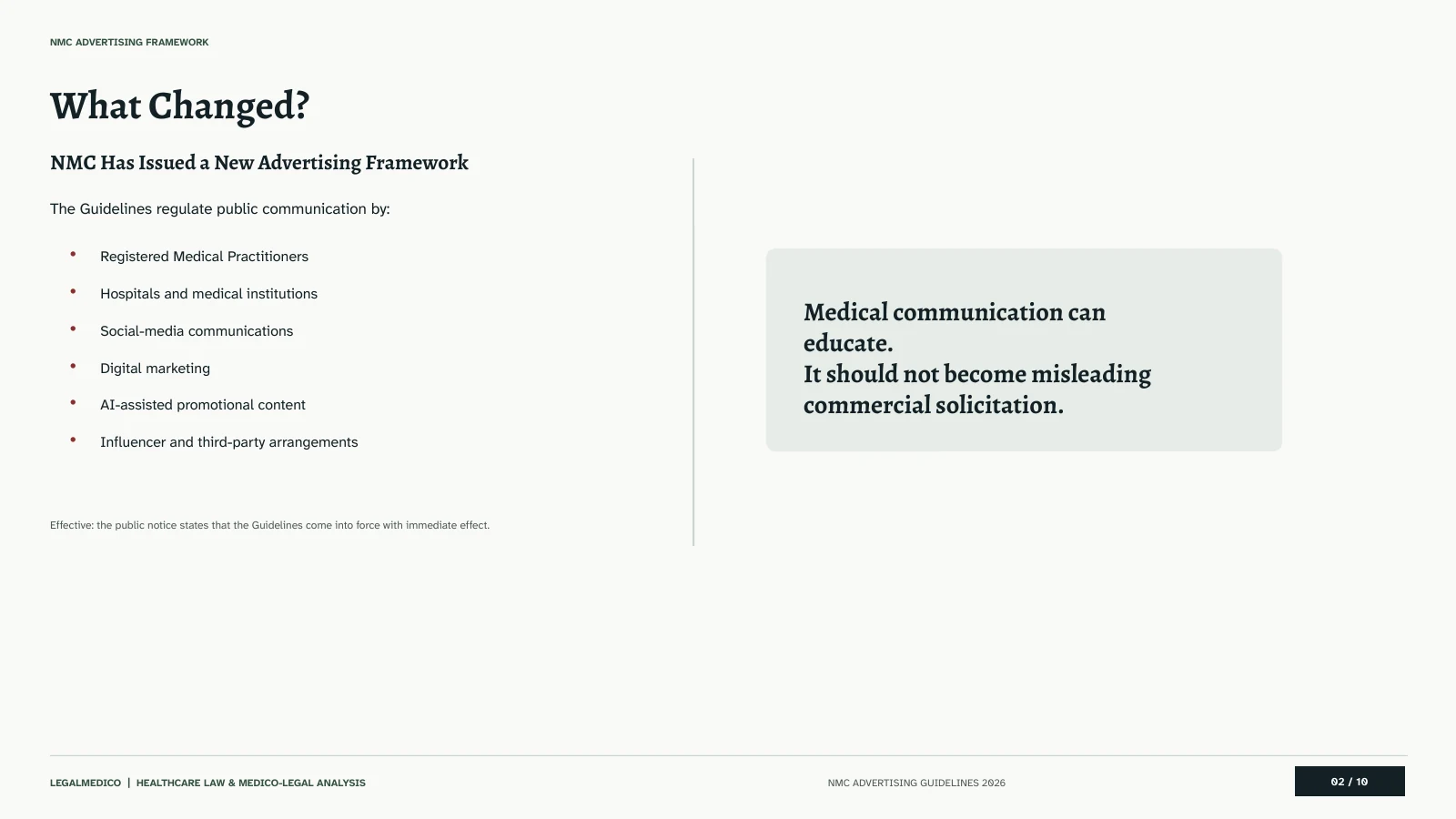
The 2026 framework reaches into the modern healthcare marketing ecosystem: websites, social media, testimonials, paid reviews, rankings, influencers, digital engagement, referral economics, limited-period offers, AI-generated communication and institutional advertising.
A practical way to read the healthcare advertising landscape
Factual Communication
Accurate, objectively verifiable professional or institutional information presents a different ethical issue from solicitation, unsupported superiority or outcome promises.
Review Carefully
Methodology, purpose, disclosure, consent and the overall impression created by the communication can materially change the analysis.
Promotional Influence
These techniques may shift communication from neutral information towards endorsement, solicitation, inducement or implied clinical outcome.
Artificial Reputation
Manufactured reputation, misleading clinical claims and patient procurement arrangements are fundamentally different from ordinary professional communication.
| Digital activity | LegalMedico reading | Why |
|---|---|---|
| Factual doctor or hospital website | Generally lower risk | Subject to accuracy and the limits applicable to professional information. |
| Genuine educational health post | Generally lower risk | Where genuinely educational rather than disguised solicitation or self-promotion. |
| Independent organic patient review | Different question | Different from a review procured, incentivised, purchased or manipulated by the professional or institution. |
| Paid patient testimonial | Red flag | Promotional testimonials and patient endorsements receive specific regulatory scrutiny. |
| Influencer recommendation reel | High scrutiny | Third-party endorsement and the material commercial relationship become relevant. |
| Buying reviews or ratings | Red flag | The Guidelines expressly address procuring, manipulating or paying for reviews and ratings. |
| Buying followers, likes, comments or views | Red flag | Artificial engagement used to manufacture professional standing is specifically addressed. |
| Transparent technical SEO | Context dependent | Legitimate discoverability is not necessarily the same as misleading manipulation of professional standing. |
| Opaque “Top Doctor” paid ranking | High scrutiny | Methodology, independence, transparency and verifiability become critical. |
| Agency paid per patient conversion | Serious concern | The Guidelines expressly address consideration linked to procurement or referral of individual patients. |
| Fixed professional agency retainer | Different structure | The compensation structure is different, although the resulting communication must still comply. |
The Guidelines, visually explained
What counts as advertising under the 2026 Guidelines?
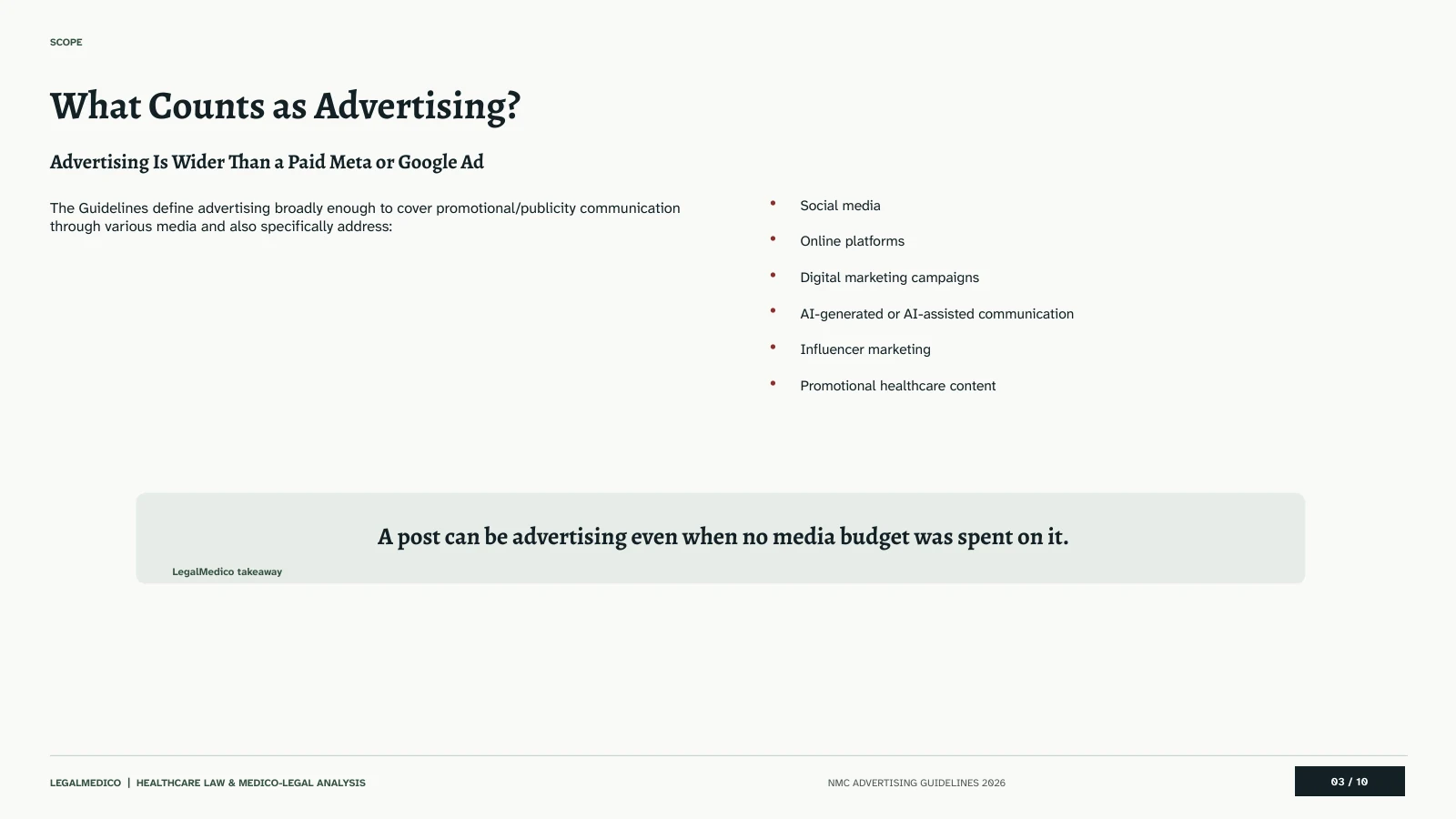
The framework adopts a broad approach to advertising and public communication. The relevant medium may include websites, print, social media, television, digital platforms, sponsored communication, influencer marketing, podcasts, artificial-intelligence-assisted content and other public-facing promotional media.
The practical effect is important: regulatory analysis cannot be reduced to the question of whether money was paid to “boost” an advertisement. A reel, ranking, recommendation, testimonial, sponsored interview, agency campaign or third-party communication may still acquire a promotional character.
Paid reviews, ratings and manufactured professional reputation
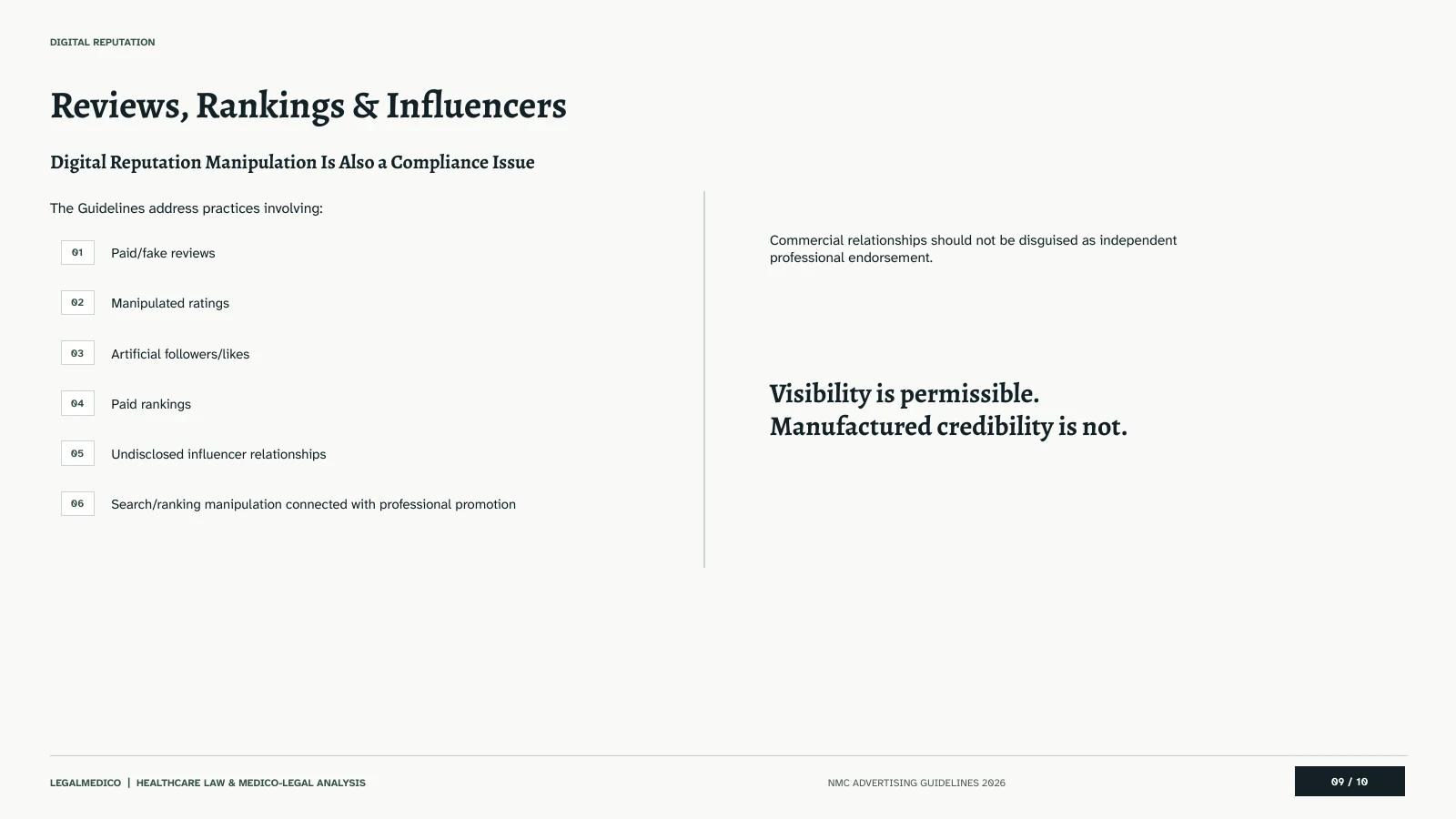
The Guidelines expressly address procuring, manipulating or paying for followers, likes, reviews, ratings, testimonials, comments, views and other forms of digital engagement where the result is a misleading impression of professional standing.
This extends the analysis beyond obviously fabricated Google reviews. The broader concern is the commercial manufacture of apparent professional credibility.
Real-world situations requiring scrutiny
- an agency promising a fixed number of five-star reviews;
- paid patient-review packages;
- coordinated rating campaigns;
- purchased followers or engagement;
- fabricated patient testimonials;
- automated engagement systems;
- reputation campaigns designed to appear independent when they are commercially arranged.
Influencer reels, celebrity endorsements and indirect healthcare marketing
The Guidelines address promotion involving celebrities, influencers, patients, employees and third parties. They also restrict the use of an intermediary to accomplish indirectly what the professional or institution could not appropriately do directly.
Payment, free treatment, creative direction, talking points or another material benefit may originate here.
Influencer, celebrity, patient creator, employee, agency or health portal publishes the communication.
The communication may appear to be an independent recommendation when it is actually commercially arranged.
“Top Doctor”, “Most Trusted”, rankings and healthcare awards
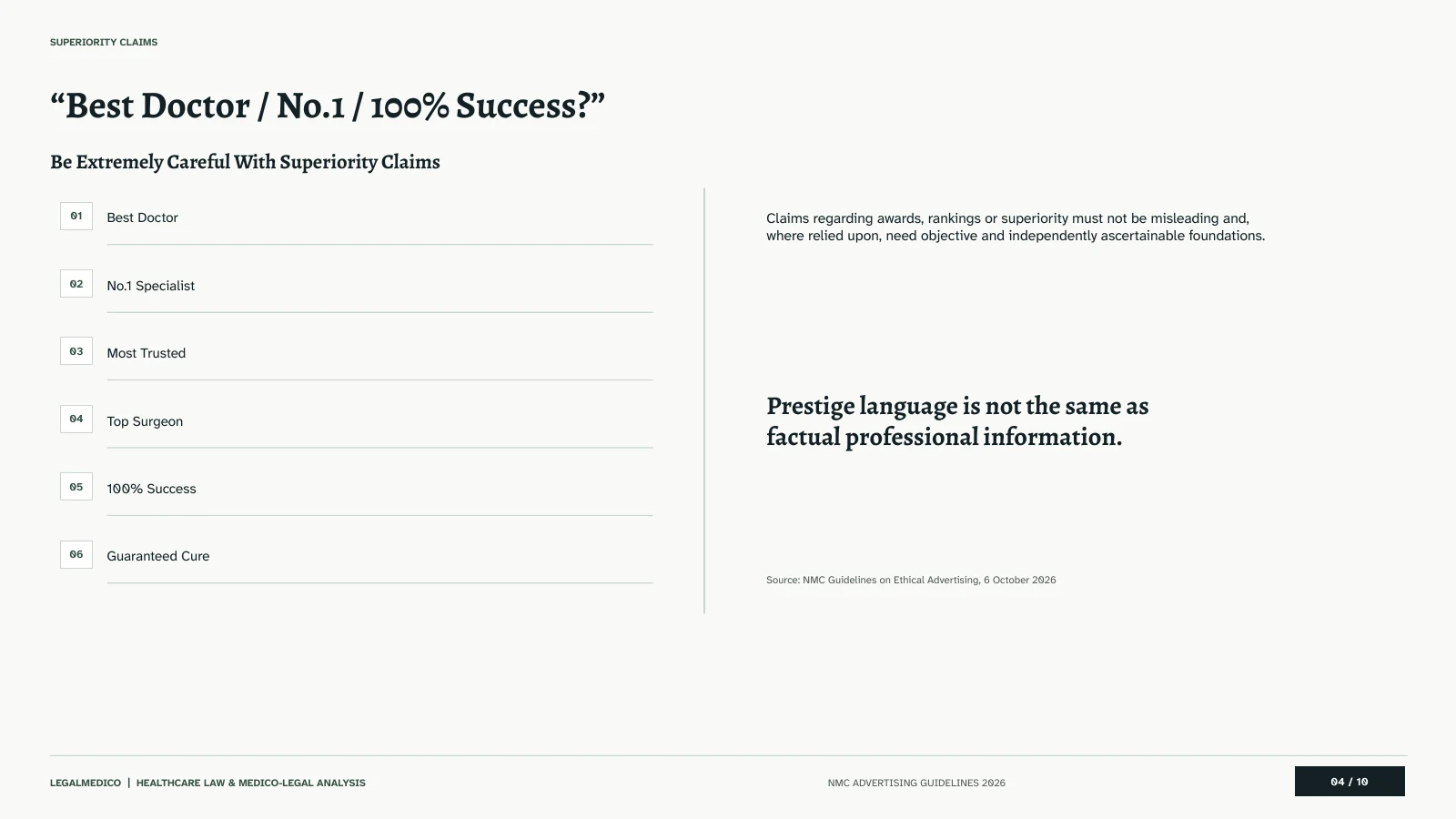
The Guidelines address comparative expressions such as “leading”, “most trusted”, “top”, “number one”, “unmatched” and similar superiority claims.
Where rankings or awards are relied upon in advertising, the important questions include objective verifiability, methodology, independence, material conditions and whether the communication creates a broader claim of superiority than the underlying ranking actually establishes.
The LegalMedico Award & Ranking Test
Independent organisation, commercial publisher, event organiser or marketing company?
Entry fee, sponsorship, advertising package, listing fee or other commercial consideration?
Clinical outcomes, infrastructure, public voting, survey, editorial selection or an undisclosed method?
A badge by itself does not explain how the underlying ranking was produced.
Professional, institution, city, department, speciality, popularity or another category?
A narrow category recognition should not automatically become a sweeping claim of professional superiority.
SEO is not automatically prohibited—but misleading search manipulation is different
The Guidelines also refer to manipulation of search rankings, visibility or algorithms where the purpose or effect is to create a misleading impression of professional standing.
This should not be reduced to the proposition that doctors or hospitals “cannot do SEO”.
Lead-generation fees, referral economics and paying agencies per patient
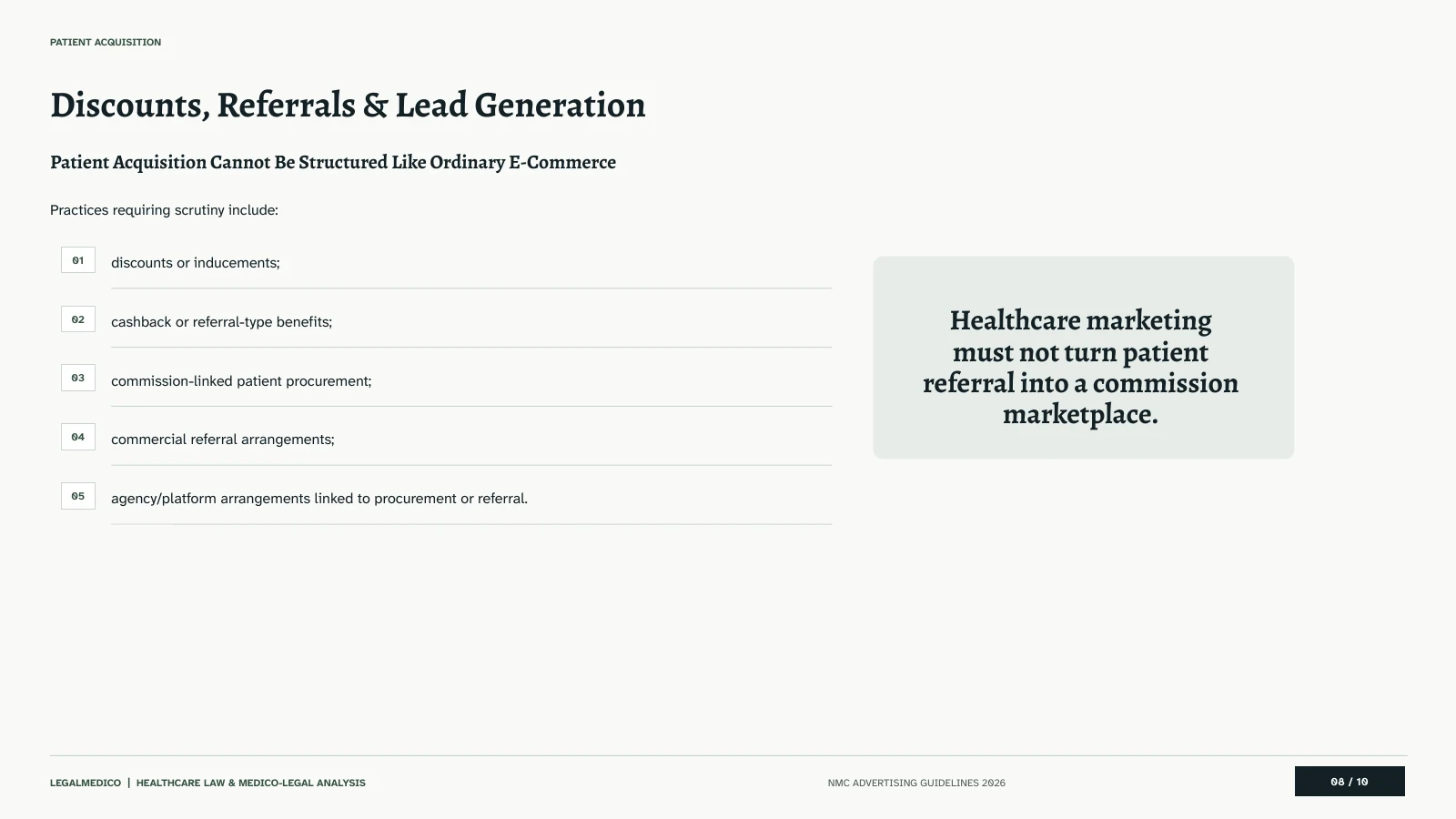
The Guidelines address commissions, rebates, bonuses, gifts, gratuities, referral fees, lead-generation fees and other consideration connected with referral, recommendation or procurement of patients or medical business.
They also specifically address arrangements involving advertising agencies, digital marketing agencies, influencers and online platforms where payment or consideration is linked to procurement or referral of individual patients.
Discounts, cashback, coupons and medical-treatment inducements
The Guidelines address discounts, limited-period offers, contests, coupons, gifts, cashback, referral benefits, free procedures and similar inducements where they are used in a manner likely to encourage unnecessary consultation, investigation or treatment, or otherwise amount to solicitation.
This should be distinguished from factual and transparent disclosure of lawful charges, packages or fees.
Patient testimonials, success stories and before-and-after material
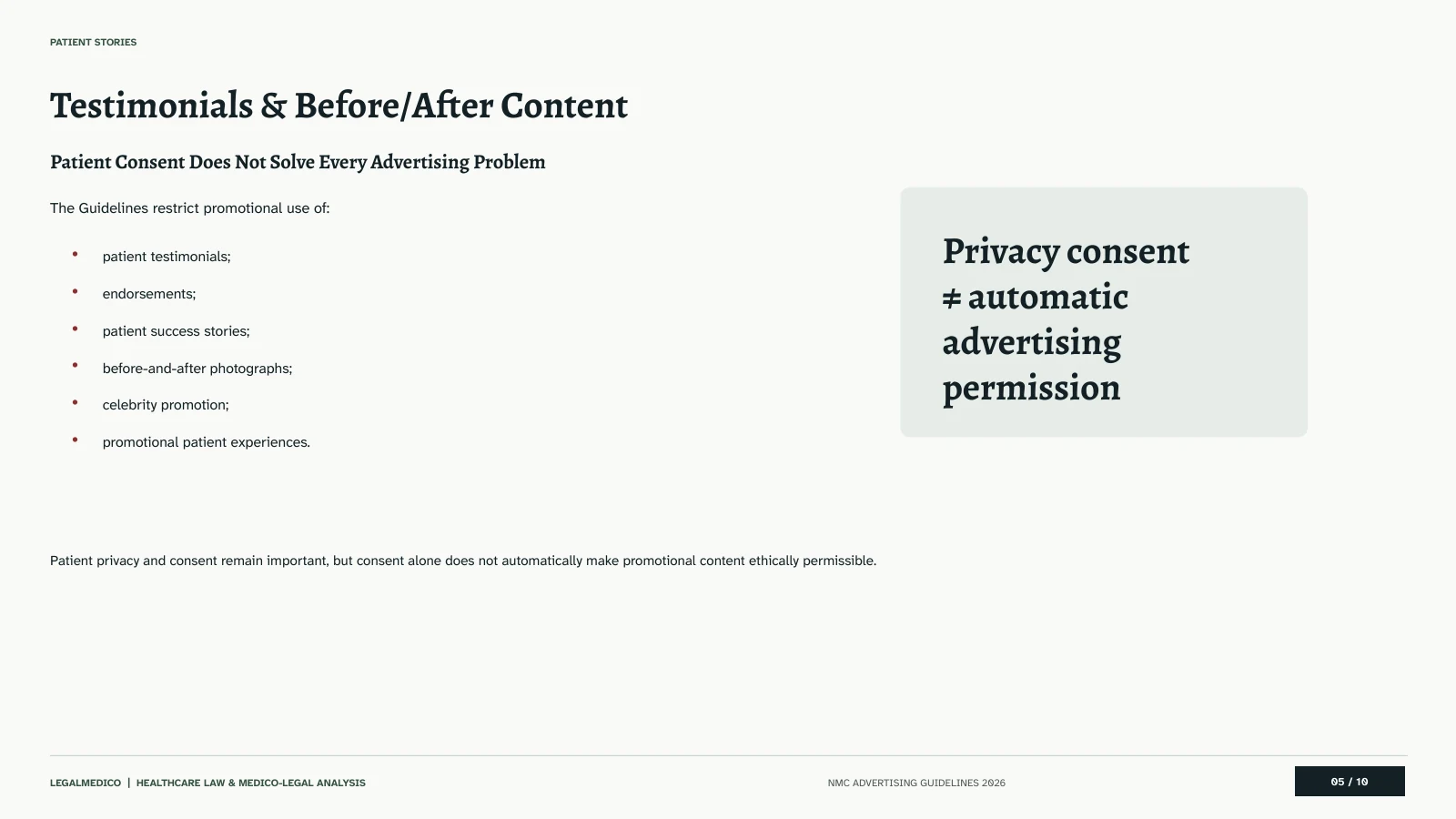
The Guidelines state that patient consent does not by itself make permissible a testimonial, endorsement, promotional patient story, before-and-after depiction, success claim or another advertising practice that is otherwise restricted.
Where consent is legally required, the Guidelines also emphasise that it should be specific, informed, voluntary and documented and that unnecessary disclosure of patient identity should be avoided.
Public-health education is different from self-promotional marketing
The Guidelines recognise participation by medical practitioners in public-health campaigns, academic discussions, educational content and health-education initiatives where the purpose is genuinely educational and not promotional solicitation.
This distinction matters for doctors who publish explanatory videos, write articles, speak at conferences or participate in media discussions. Educational communication should not be converted into disguised superiority claims, commercial endorsement or outcome-driven promotion.
AI-generated medical advertising: not every use of AI is the same
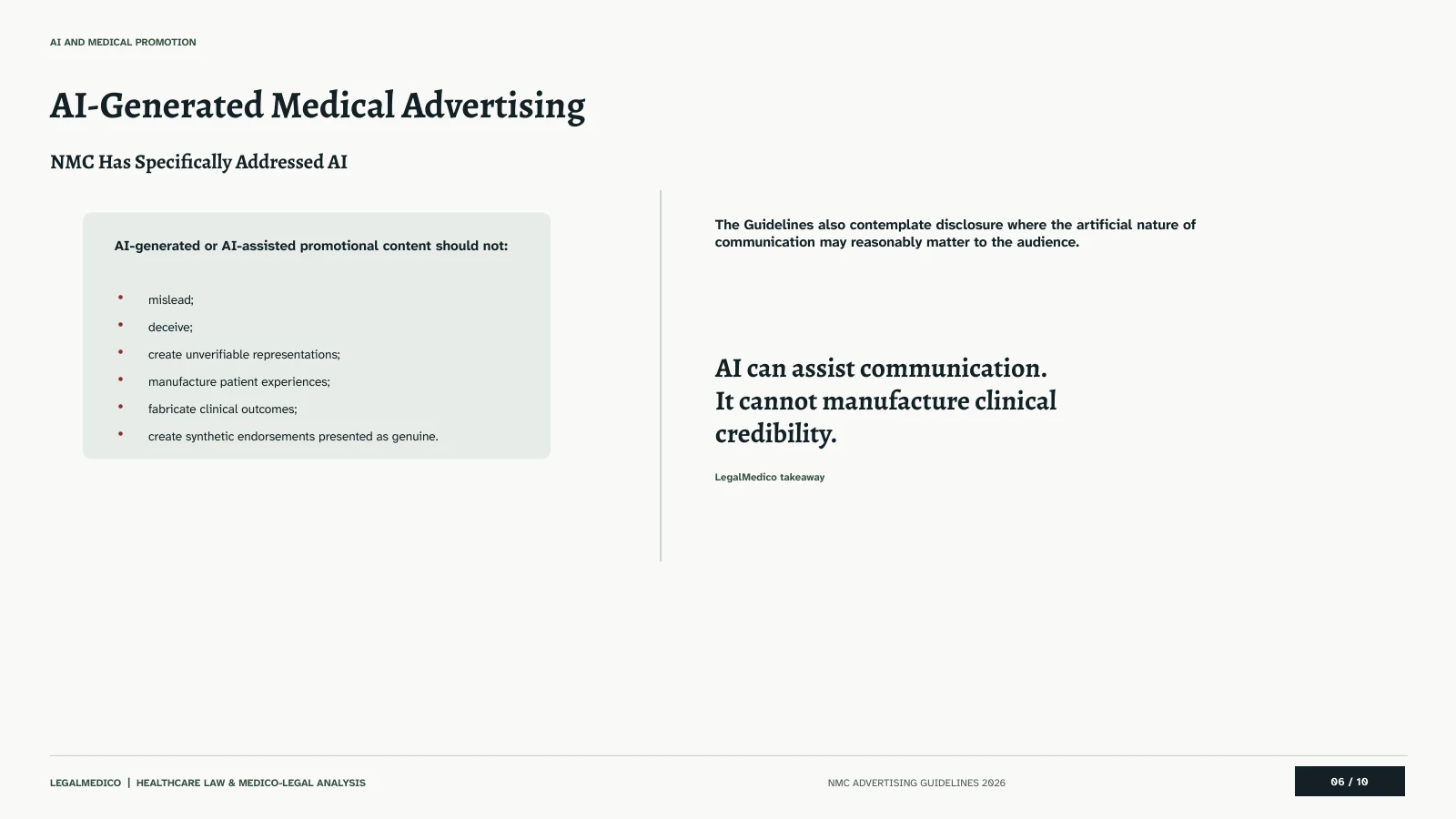
The Guidelines specifically address AI-generated and AI-assisted promotional communication.
They restrict misleading or unverifiable representations concerning diagnosis, treatment, outcomes, professional qualifications, patient experiences and healthcare services and specifically address synthetic patient images, testimonials, voices, clinical outcomes and endorsements purporting to represent actual persons.
Hospital and medical-institution advertising
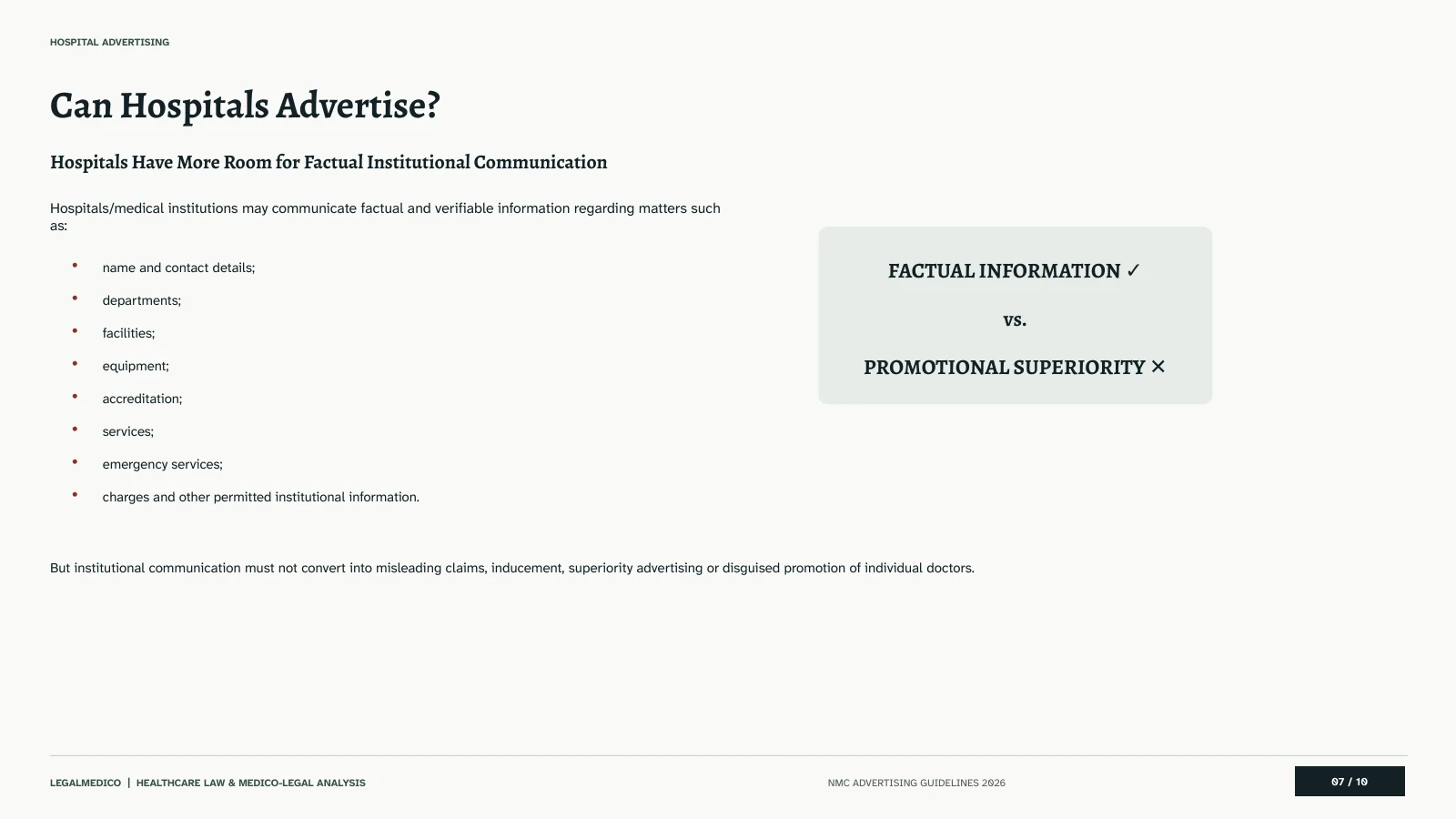
The Guidelines permit hospitals and medical institutions to communicate factual, objective and verifiable institutional information such as name, location, contact details, departments, facilities, equipment, services, emergency services, accreditation status, charges and other information permitted by law.
Such communication should not be converted into patient solicitation, inducement, comparative superiority, guarantees of cure or treatment outcome, unverifiable claims or promotional portrayal of individual medical practitioners.
What can happen if the Guidelines are violated?
The Guidelines contemplate graded disciplinary action for Registered Medical Practitioners through the concerned State Medical Council, subject to the NMC Act, applicable regulations and principles of natural justice.
The Guidelines identify examples including misleading cure claims, patient inducement and digital mass solicitation.
Twelve questions before a healthcare campaign goes live
Common questions under the NMC Advertising Guidelines 2026
Can doctors advertise in India?
Medical practitioners may communicate permitted factual professional information and genuine educational material, but professional advertising remains subject to ethical restrictions. The actual content and context therefore matter.
Can doctors ask patients to leave Google reviews?
The Guidelines expressly address procuring, manipulating or paying for reviews and ratings to create a misleading impression of professional standing. An independently posted genuine review is a different factual situation from purchased, incentivised or manipulated reputation activity.
Can a doctor repost a positive patient review?
Reusing patient praise as promotional content may create a separate testimonial or endorsement issue even where the original review was independently written.
Can doctors pay influencers for reels?
The commercial relationship, content of the reel and applicable professional restrictions all need review. Sponsorship disclosure does not automatically make an otherwise restricted endorsement permissible.
Can hospitals use “Top Hospital” or “No.1” awards?
Comparative claims and relied-upon rankings require scrutiny for objective verification, methodology, transparency, independence and whether the advertisement overstates what the ranking actually establishes.
Can doctors and hospitals do SEO?
The Guidelines address manipulation of search rankings, visibility or algorithms used to create a misleading impression of professional standing. This should not automatically be equated with legitimate technical SEO or factual website optimisation.
Can a healthcare marketing agency charge per patient?
The Guidelines specifically address arrangements where payment or consideration is linked to procurement or referral of individual patients. Such arrangements require serious compliance review.
Can hospitals advertise discounts?
Discounts, coupons, cashback, referral benefits and similar inducements receive particular scrutiny where they encourage unnecessary consultation, investigation or treatment or otherwise amount to solicitation. Transparent disclosure of lawful charges is a different issue.
Does patient consent make a testimonial permissible?
No automatic rule applies. The Guidelines expressly distinguish patient consent from the separate question whether a testimonial, endorsement, success story or before-and-after promotion is professionally permissible.
Can AI-generated material be used in healthcare communication?
AI use requires context-specific analysis. Clearly contextualised educational illustration presents a different issue from synthetic patient experiences, fabricated clinical results or generated testimonials presented as genuine.
How this LegalMedico analysis was prepared
OCT
2026
National Medical Commission
Guidelines on Ethical Advertising and Public Communication by Hospitals/Medical Institutions and Registered Medical Practitioners
This LegalMedico analysis should be read together with the original NMC Guidelines and any subsequent clarification, amendment, regulatory order or judicial development.
View Official NMC Updates →
Adv. Lokesh Bagani
Advocate Lokesh Bagani writes on healthcare law, medico-legal regulation, hospital compliance, medical advertising, healthcare disputes, cyber law and emerging AI and health-tech legal issues. LegalMedico's editorial work focuses on translating healthcare regulation, litigation risk and legal developments into practical, source-led analysis for healthcare professionals, institutions, patients and healthcare businesses.
This publication is provided by LegalMedico solely for general legal awareness, regulatory education and informational purposes. It does not constitute legal advice, medical advice, advertisement, solicitation, an invitation to engage professional services or a representation that any particular course of action is appropriate in an individual matter.
The analysis is based on the regulatory material identified on this page and the legal position reviewed as on the stated review date. Healthcare regulation, professional ethics, advertising standards, privacy requirements, platform policies, statutory provisions and judicial interpretations may subsequently change, be clarified or apply differently according to the facts.
The classifications, examples, risk indicators, decision tools, tables, compliance labels and “LegalMedico explains” sections are educational analytical tools. Unless expressly stated otherwise, they should not be understood as verbatim classifications or formal determinations issued by the National Medical Commission or another regulatory authority.
Any hypothetical advertising, influencer, review, ranking, agency or patient examples used on this page are fictional and are not intended to refer to or identify any particular doctor, hospital, patient, advertiser, agency or LegalMedico client.
Patient consent, sponsorship disclosure, disclaimer language, AI disclosure or approval by a marketing agency does not by itself establish compliance with all applicable professional, privacy, consumer-protection, advertising or other legal requirements.
No advocate-client relationship, professional engagement or duty of representation is created merely by accessing this page, reading this publication, sending an email or sharing information through LegalMedico.
For an actual campaign, regulatory notice, disciplinary proceeding or professional communication, the original Guidelines, applicable law and the specific facts should be independently examined.