
Medical Negligence · Diagnostic Error · Oncology
Cancer Suspected. Chemotherapy Started. Later: Tuberculosis.₹23.36 Lakh Compensation Ordered
A recent Rajasthan compensation order raises a difficult medico-legal question: when treatment begins on a serious diagnosis, what must the record show — and when should that diagnosis be reconsidered? The reported medical negligence dispute brings cancer misdiagnosis, chemotherapy, diagnostic certainty and clinical reassessment into the same legal frame.


A Permanent Lok Adalat in Rajasthan has reportedly awarded ₹23,36,774 in a medical negligence dispute in which chemotherapy was commenced after investigations raised suspicion of cancer, while subsequent evaluation reportedly resulted in a diagnosis of tuberculosis. The case raises a broader question: when can a diagnostic error, treatment decision or failure to reassess an evolving clinical picture cross the line into medical negligence?
The compensation figure makes the headline. The more important medico-legal issue lies underneath it.
A later diagnosis does not, by itself, prove that an earlier diagnosis was negligent. Medicine permits genuine diagnostic uncertainty. Tuberculosis can, in some presentations, resemble malignancy clinically and radiologically. The harder question is whether the original diagnosis and treatment decision were reasonably supported by the evidence then available — and whether the evolving clinical picture later created a duty to reassess that diagnosis.
₹20 lakh reportedly for mental agony, physical suffering and financial loss, plus ₹3,36,774 toward documented medical expenses.
Was treatment reasonably justified when it began, and did later evidence require the working diagnosis to be reconsidered?
The primary Permanent Lok Adalat order was not publicly available in the sources reviewed for this article. Published reports are also inconsistent on the starting date and total duration of chemotherapy. LegalMedico therefore does not state that treatment continued for “two years” and does not reproduce party identities. The analysis below addresses the broader medico-legal issues arising from the reported facts and does not purport to restate the complete findings of the adjudicating forum.
What Reportedly Happened?
Multiple reports published on 29–30 August 2026 state that a patient from Rajasthan presented with abdominal symptoms and underwent investigations at the recommendation of a treating institution. The reports say those investigations raised suspicion of cancer and chemotherapy was subsequently commenced.
The patient's condition reportedly did not improve as expected. In January 2023, further evaluation at another institution reportedly identified tuberculosis rather than cancer, and the TB diagnosis was subsequently confirmed elsewhere. Reports state that the patient's condition improved after anti-tuberculosis treatment.
The Permanent Lok Adalat reportedly awarded ₹23.36 lakh. Importantly, the reported compensation for medical expenses was limited to ₹3,36,774 supported by bills, while a larger expense claim was not accepted for want of sufficient documentary proof.
Those reported facts raise two separate questions that should not be collapsed into one:
Medical Negligence: When Can a Wrong Cancer Diagnosis Cross the Line?
Indian medical-negligence law does not demand perfect outcomes or infallible diagnosis. The Supreme Court has repeatedly recognised that a medical professional is expected to possess and exercise a reasonable degree of skill, knowledge and care; liability does not arise merely because another professional later reaches a different conclusion.
In Kusum Sharma v. Batra Hospital & Medical Research Centre, the Supreme Court emphasised that a practitioner is not negligent merely because one professional opinion differs from another. The inquiry is whether the conduct fell below the standard reasonably expected from a competent practitioner in that field.
Diagnostic error asks whether the diagnosis ultimately proved incorrect.
Negligent diagnosis asks whether the diagnostic process, interpretation, treatment decision or subsequent reassessment fell below the legally relevant standard of reasonable care.
This distinction protects both sides. Patients should not be denied redress where a serious departure from reasonable care causes harm. Doctors should not be judged negligent simply because medicine later revealed a different diagnosis.
The central legal point is simple: medical negligence is not established by a changed diagnosis alone; it depends on the reasonableness of the diagnostic process, treatment decision, reassessment and causal harm proved on the record.
Cancer or Tuberculosis: Why Hindsight Can Mislead
Tuberculosis is capable of mimicking malignancy in some clinical settings. Published medical literature documents extrapulmonary, pulmonary and abdominal TB presenting with findings that resemble cancer, including on imaging. Depending on the organ involved and the disease pattern, tissue sampling and microbiological or histopathological correlation may be required to distinguish competing diagnoses.
That matters legally. If two diseases can plausibly resemble each other, the mere fact that the second diagnosis was ultimately correct does not establish that the first clinician must necessarily have been negligent.
The analysis must return to the evidence available at the time of each clinical decision.

How Certain Should a Cancer Diagnosis Be Before Chemotherapy?
There is no single diagnostic sequence applicable to every malignancy. Different cancers have different diagnostic pathways, and there are clinical circumstances in which treatment decisions may need to be made without the same type of tissue confirmation.
But as a general medical proposition, the National Cancer Institute describes biopsy as the preferred method for confirming cancer in many settings, and pathology reports are central to establishing the diagnosis and guiding treatment. Imaging, laboratory investigations, molecular studies and the overall clinical picture may also play crucial roles.
From a medico-legal perspective, the question is therefore not simply:
“Was a biopsy done?”
The stronger question is:
The more consequential and toxic the treatment, the more important it becomes that the record explains the diagnostic basis, the treatment indication, the alternatives considered where relevant, and the patient's informed-consent process.
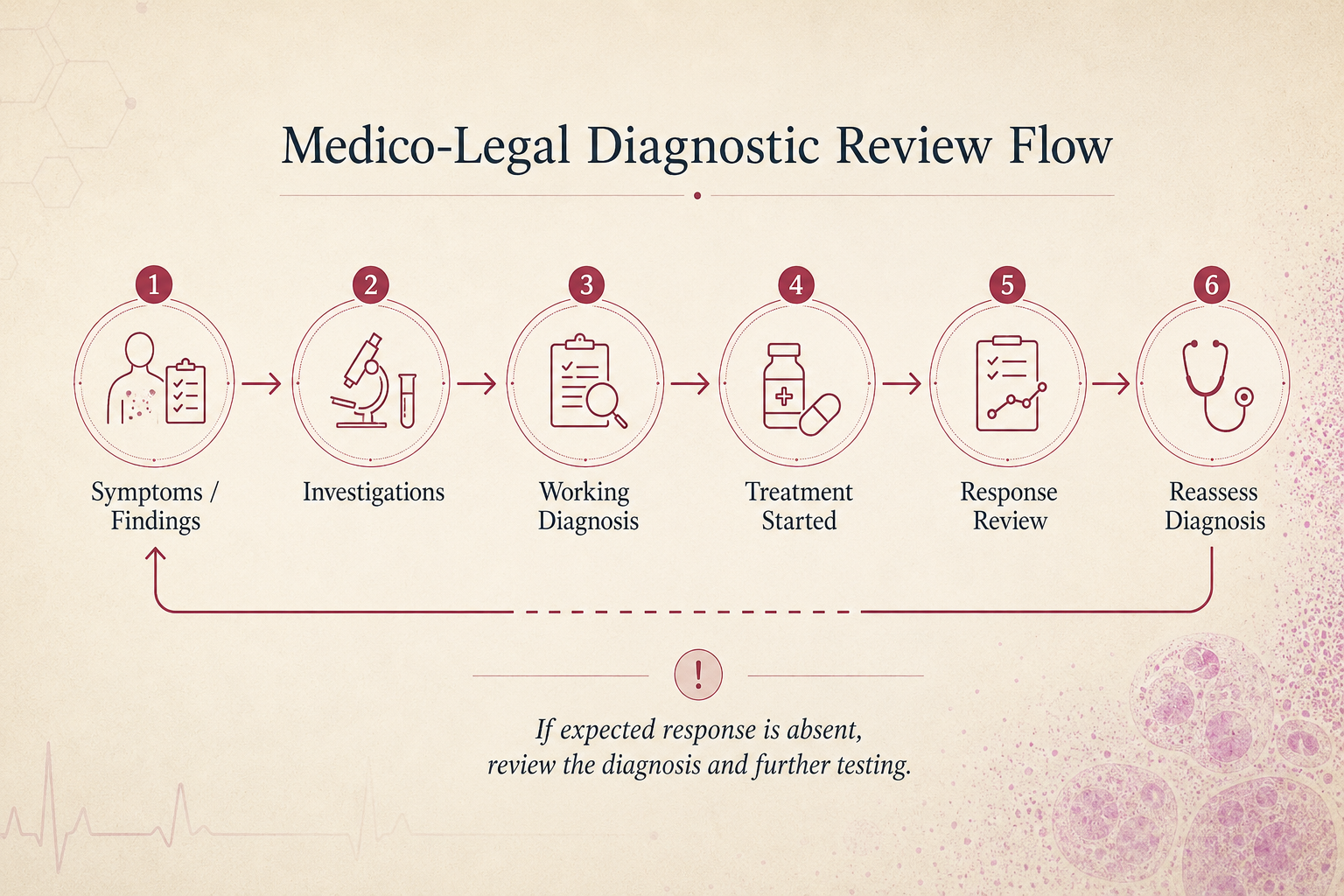
The Bigger Issue: When Must the Diagnosis Be Reconsidered?
A diagnosis is not frozen on the day it is written.
Treatment generates new information. Symptoms may improve, persist or worsen. Imaging may evolve. Laboratory findings may change. New pathology or microbiological information may emerge. Expected treatment response may fail to appear.
That means the medico-legal issue can change over time.
An initial working diagnosis may have been clinically defensible. But if subsequent evidence becomes inconsistent with that diagnosis, the record may need to show whether the treating team recognised the discrepancy, reconsidered competing diagnoses, reviewed earlier material, ordered further investigation, modified treatment or sought additional expertise where clinically appropriate.
What Would the Medical Record Need to Answer?
If a dispute of this nature reaches an adjudicating forum, recollection years later is unlikely to be enough. The contemporaneous record becomes central.
| Stage | Clinical question | Medico-legal record |
|---|---|---|
| Presentation | What symptoms, signs and differentials were present? | History, examination, provisional diagnosis and differential diagnosis. |
| Investigation | What supported or contradicted malignancy? | Imaging, laboratory reports, pathology/cytology where applicable, specialist interpretation. |
| Treatment decision | Why was chemotherapy selected? | Diagnosis being treated, indication, regimen, objective of treatment, consent and treatment plan. |
| Response review | Was the expected response occurring? | Serial notes, imaging, laboratory trends, toxicity, clinical response and treatment modifications. |
| Reassessment | Did evolving evidence require the diagnosis to be revisited? | Repeat investigations, pathology review, differential reconsideration, multidisciplinary review or referral where indicated. |
| Damage | What harm is alleged to have resulted? | Treatment records, adverse-effect documentation, subsequent diagnosis, expenses and evidence of consequential loss. |

The Defensible Medical Record Is a Reasoning Record
One of the recurring weaknesses in medico-legal disputes is that the clinician may have had a defensible thought process, but the record contains only the final instruction: “continue treatment”, “review after cycle”, or “same treatment”.
That gap matters because an adjudicator does not see the clinical conversation in the doctor's mind. The adjudicator sees the notes, reports, investigations, consent forms and chronology.
- the diagnostic basis at treatment initiation;
- the degree of certainty and any unresolved differential;
- the treatment objective and expected response;
- the parameters used to assess response;
- why treatment was continued, modified or stopped;
- what new evidence was considered when the patient did not improve as expected;
- why repeat pathology, imaging, microbiology, referral or multidisciplinary review was — or was not — clinically indicated.
The defence of a clinical decision is usually strongest when the contemporaneous record explains not only what was done, but why it remained reasonable to do it.
Diagnostic Governance: Where Hospital Systems Matter
A hospital cannot guarantee that every diagnosis will be correct. It can, however, design systems that reduce the chance that an uncertain diagnosis becomes an unquestioned diagnosis.
In high-risk treatment pathways, useful governance questions may include:
- Is the diagnostic basis visible before treatment is authorised?
- Are equivocal pathology or imaging findings flagged for review?
- Is there a mechanism for clinicopathological/radiological correlation?
- Are treatment-response checkpoints built into protocols?
- Does unexplained non-response trigger reassessment?
- Can clinicians easily obtain an internal second review when the evidence is discordant?
- Are pathology slides, blocks, imaging and reports retained and retrievable according to applicable requirements?
That is not defensive medicine. Properly designed, it is clinical governance.
Questions Patients Can Reasonably Ask Before and During Treatment
Patients facing a cancer diagnosis are often told simply to “take a second opinion”. That can be useful in appropriate cases, but it is not a substitute for understanding the first opinion.
More useful questions are:
- What exactly confirms my diagnosis?
- Is the diagnosis final, probable or still being investigated?
- What is the purpose of the proposed chemotherapy?
- What benefit is expected and how will response be measured?
- When will the treatment plan be formally reviewed?
- If my condition does not respond as expected, what alternative explanations will be considered?
Patients should not interpret these questions as evidence that their treating team is wrong. They are part of informed participation in a serious treatment decision.
Compensation Is Also an Evidence Question
The reported order contains a second practical lesson that is easy to miss.
Reports state that although a substantially higher amount was claimed toward medical expenses, the adjudicating forum accepted ₹3,36,774 supported by bills. The larger claimed expense was reportedly not accepted for want of adequate documentary proof.
Where compensation is claimed, preserving the financial trail can be as important as preserving the clinical trail.
- prescriptions and treatment orders;
- pathology and laboratory reports;
- imaging reports and, where available, images;
- discharge summaries and chemotherapy records;
- hospital and pharmacy bills;
- payment receipts;
- subsequent diagnostic reports;
- referral and second-opinion records;
- relevant communications concerning treatment and follow-up.
What This Reported Case Does NOT Mean
- It does not mean every wrong diagnosis amounts to medical negligence.
- It does not mean tuberculosis and malignancy can always be easily distinguished at the first encounter.
- It does not mean every failure to respond to chemotherapy proves that the original diagnosis was wrong.
- It does not mean every cancer patient requires an identical set of confirmatory investigations.
- It does not mean chemotherapy itself creates liability merely because the outcome is poor.
- It does not allow conclusions about an individual clinician's conduct without examining the actual medical record and the complete adjudicatory order.
Medical Negligence: The LegalMedico Takeaway
The most useful lesson from this reported proceeding is not that diagnostic errors automatically equal negligence. They do not.
The stronger lesson is that diagnosis is a continuing clinical process. The initial decision must be supportable on the evidence available when it is made. As treatment continues, new evidence must be capable of changing the working diagnosis when circumstances reasonably require it.
In practice, that means documenting clinical reasoning and response review, building systems for diagnostic correlation and reassessment, and ensuring that patients can understand what supports the diagnosis and how treatment response will be assessed.
Frequently Asked Questions
Does a wrong diagnosis automatically amount to medical negligence in India?
No. A diagnosis that later proves incorrect is not automatically negligent. The legal inquiry examines whether the practitioner exercised the degree of skill and care reasonably expected in the circumstances, based on the information available at the relevant time.
Can tuberculosis be mistaken for cancer?
In some presentations, yes. Medical literature documents forms of pulmonary, extrapulmonary and abdominal tuberculosis that can mimic malignancy clinically or radiologically. The appropriate diagnostic work-up depends on the patient's presentation and suspected disease.
Is biopsy always mandatory before chemotherapy?
No universal rule should be stated across every cancer and clinical circumstance. Tissue diagnosis is central and often preferred for confirming malignancy, but the correct diagnostic pathway depends on the suspected cancer, clinical context, urgency and applicable medical practice. The medico-legal question is whether the treatment decision was reasonably supported in that particular case.
Can failure to improve on chemotherapy itself prove negligence?
No. Non-response may occur for many reasons, including disease biology and treatment resistance. Its medico-legal significance lies in whether the changing clinical picture was appropriately monitored, interpreted and reassessed.
What records are important in a diagnostic-error claim?
Initial consultation notes, imaging, pathology/cytology, laboratory records, treatment plans, consent documentation, response assessments, repeat investigations, referral records, later diagnostic records and proof of expenses may all become relevant depending on the allegations.
What should hospitals learn from this type of dispute?
The central governance lesson is to make the diagnostic basis, treatment indication, response-review process and escalation/reassessment pathway traceable in the medical record, particularly for high-risk treatments.
Sources & Legal References
- The New Indian Express, report dated 30 August 2026. Note: its treatment chronology differs from several other contemporaneous reports.
- IANS-derived report, 30 August 2026, reporting the 24 August 2026 Permanent Lok Adalat order and compensation breakdown.
- Arun Kumar Manglik v. Chirayu Health and Medicare Pvt. Ltd., Supreme Court of India, 9 January 2019, discussing the reasonable skill-and-care standard and Kusum Sharma principles.
- Kusum Sharma & Ors. v. Batra Hospital & Medical Research Centre & Ors., Supreme Court of India, 10 February 2010.
- US National Cancer Institute — Pathology Reports.
- US National Cancer Institute SEER Training — Cancer Diagnosis.
- Abdominal visceral tuberculosis: a malignancy mimic, peer-reviewed medical literature.
- Extrapulmonary Tuberculosis Mimicking Malignancy, peer-reviewed medical literature, 2026.
Advocate Lokesh Bagani
Advocate Lokesh Bagani writes on healthcare law, medico-legal regulation, medical negligence, hospital documentation, patient rights, healthcare compliance and emerging legal-risk issues affecting medical professionals, healthcare institutions and patients.
His LegalMedico work focuses on how clinical decision-making, medical records, informed consent, legal duties and evidentiary principles interact in healthcare disputes.
View Founder & Editor Profile →