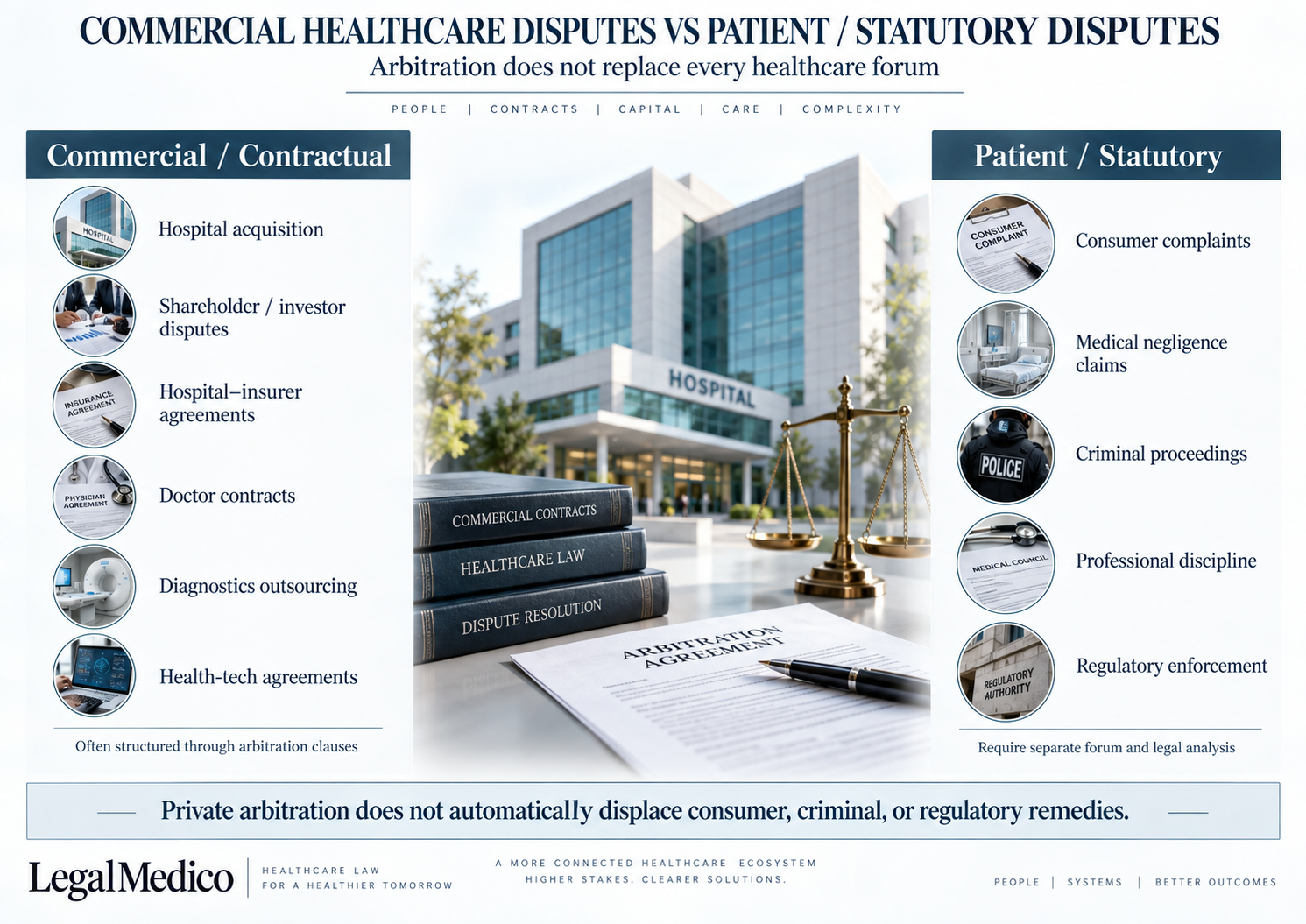


What it does not claim: that all healthcare disputes are arbitrable, or that patient consumer claims, criminal proceedings or regulatory jurisdiction can be contracted away.
Healthcare arbitration in India is becoming increasingly relevant at the commercial and institutional layer of healthcare. Ask a lawyer what a healthcare dispute looks like and medical negligence will probably be the first answer. That picture is now incomplete. Behind a modern hospital sits a network of investors, promoters, insurers, third-party administrators, doctors, diagnostic operators, software vendors, equipment suppliers, landlords, management companies and sometimes public authorities. Their relationships are governed not by clinical consent forms, but by healthcare contracts and commercial agreements.
That distinction matters. A hospital may simultaneously be a provider of medical services to a patient, an empanelled network provider for an insurer, an employer or principal for senior clinicians, a customer of a hospital-information-system vendor, a concessionaire, a borrower and the subject of an acquisition agreement. Each legal relationship creates a different forum question, evidence problem and risk allocation.
The commercial backdrop: healthcare is attracting capital, capacity and consolidation
The strongest evidence for the thesis is not a supposed national count of “healthcare arbitrations”—no reliable India-wide dataset presently supports such a percentage claim. The better evidence is structural: healthcare transactions, capacity expansion and private credit are increasing the number and complexity of commercial relationships around hospitals.
EY-Parthenon reported more than ₹10,000 crore of announced transactions across hospitals, diagnostics and specialty care in Q2 FY26, including buyouts, minority investments and cross-border acquisitions. The same update said leading hospital chains collectively planned more than 18,000 additional beds over the following three to five years. It also reported 10–16% year-on-year ARPOB growth across leading hospital networks. Separately, IBEF’s summary of the EY Private Credit Report H1 2026 said healthcare accounted for 13% of private-credit deal value, making it the second-largest sector by deployment.